
The Story of the People of the Cave
Young believers who held onto faith and were protected by Allah.
Jump to a chapter (optional)
1 Young believers seek refuge
The People of the Cave were a group of young believers who lived at a time when standing openly for faith was difficult. They believed in Allah and did not want to follow falsehood just because everyone around them expected it.
The Qur’an introduces the People of the Cave as young believers who sought refuge in Allah. They had rejected the worship of false gods, and they made a prayer asking for mercy and wise direction. They did not know what would happen next. Their courage was not loud or showy; it was a quiet decision to keep their faith.
2 Sleep and protection within the cave
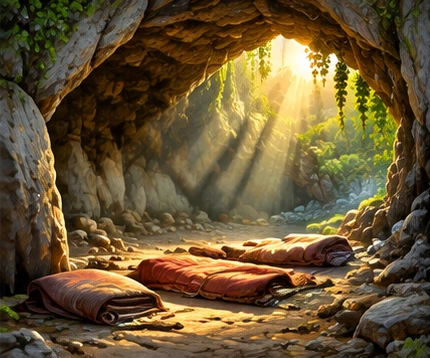
They entered the cave, and Allah caused them to sleep for many years. The Qur’an describes the sun’s light moving past their shelter and Allah protecting them while they rested. It also mentions their dog lying near the entrance. These vivid details show how carefully Allah guarded the group, though the text does not ask us to invent their names or exact location.
When the danger around them became too great, the young believers left and took shelter in a cave. They made du‘a and asked Allah to guide them and to open a path of mercy for them. That is an important lesson: when people feel overwhelmed, they should not only run from trouble. They should also turn to Allah with prayer.
Allah then caused them to sleep for a very long time. He protected them while years passed. When they eventually awoke, they thought only a short time had gone by. Soon they realised that much more time had passed and that Allah had preserved them in a remarkable way.
The young believers withdrew to the cave and prayed for Allah’s mercy and guidance. The Qur’an says Allah caused them to sleep for many years and protected them while they rested. It also mentions a dog near the cave entrance, but does not supply the familiar names and locations sometimes found in later retellings (Qur’an 18:9–18).
3 Awakening and what remains unknown
When they awoke, they thought they had been asleep for a short time. One of them took silver coins to the city to buy food, with instructions to be careful. The world outside had changed. Their story became a sign reminding people of Allah’s power to raise the dead and keep His promises.
People later disagreed about the exact number of young believers. The Qur’an directs attention away from arguing over uncertain details and towards what can be known. This is a valuable lesson for preteens: a story can teach something important even when certain facts are not supplied.
The youth of the cave show that faith belongs to the young as well as the old. When choices are difficult, believers can seek safe help, make du‘a and act wisely. Courage is not the same as taking unnecessary risks; these young people sought shelter precisely because they valued their faith and safety.
When they awoke, they thought little time had passed. One went to obtain food, and the story became a sign of Allah’s power and the promise of resurrection. The Qur’an cautions against arguing about the precise number of sleepers without knowledge. Faith and humility are more important than guesswork (Qur’an 18:19–26).
What can we learn?
Big idea: Young people can be brave in faith. Allah protects those who sincerely turn to Him.
Talk about the story
- Why is this story especially meaningful for young people?
- What did the believers do when they entered the cave?
- What does the story teach about Allah’s protection?
Additional family reflections from the earlier edition
Being young did not make their faith weak. In fact, the Qur’an highlights their courage. They chose truth even when that choice brought pressure. This is one reason the story matters so much to children and teenagers: it shows that age does not stop a person from being sincere and brave.
The story reminds us that Allah’s protection does not always look the same. Sometimes He protects people through open victory. Sometimes He protects them quietly, by guiding them, preserving them or changing their circumstances over time. His wisdom is greater than what people can immediately understand.
For children and preteens, the story teaches courage, but not stubbornness for the sake of pride. The young believers were humble. They asked Allah for help. Their strength came from faith, not from showing off. Real courage stays connected to du‘a.
Whenever a young Muslim feels that doing the right thing is difficult, the People of the Cave offer comfort. A sincere heart, even a young one, matters greatly to Allah. He sees the believer who chooses truth and asks Him for help.
Talk together: What does quiet courage look like in everyday life for a child or teenager?
Check your understanding
Answer three questions about the story, then review the explanations.
Sources and further reading
How to read these sources: Qur’anic verses are the primary text. Explanations about prophetic infallibility and other doctrines follow Twelver Shia interpretation. The child-friendly dialogue and reflections are adaptations, not quotations from scripture or hadith.
Chapter-by-chapter Qur’an guide
Read the linked Qur’anic passages for the events described. Some chapters draw on more than one passage; the links are starting points for reading the scripture, not independent authentication of every sentence in this educational retelling.
The Qur’an is the primary source for the narrative. This is an age-appropriate retelling from a Twelver Shia perspective, not a word-for-word translation or a complete tafsir. Some explanatory transitions are editorial summaries. Historical and theological details that go beyond the cited passages should be checked against qualified Shia scholarship.
How we check historical and religious content
Twelver Shia editorial note: The Qur’an discourages speculative arguments about the sleepers’ precise number. Do not present traditional names, dates or cave locations as Qur’anic certainties.
References identify where to study the passages. Translation choices, interpretations and historical additions remain subject to qualified review.
Evidence labels: Qur’an = primary scripture; Twelver Shia interpretation = theological reading; narrative transitions = educational paraphrase. Qur’anic verses are cross-referenced here, but the prose and any extra-Qur’anic details still need a qualified scholarly review.